
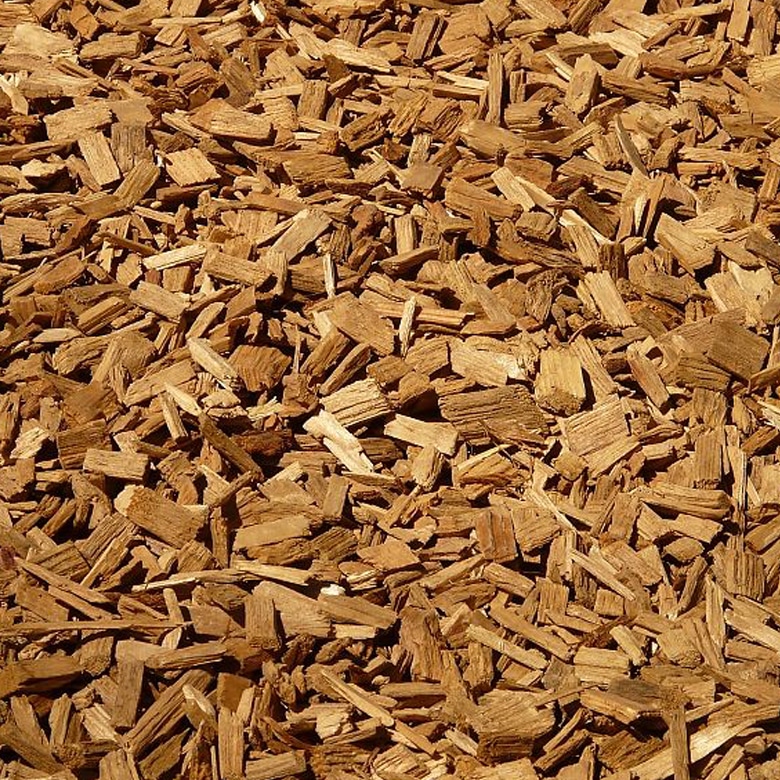
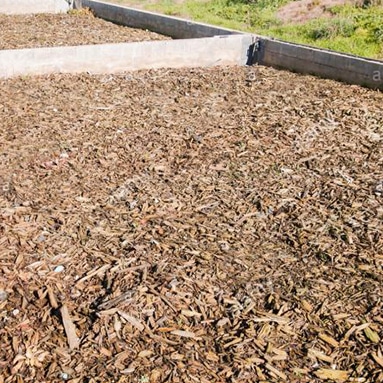
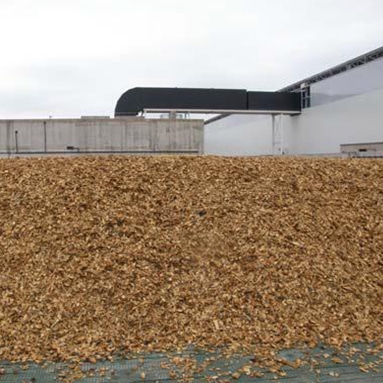

The fill material for biofilters made of treated wood chips comes from various types of pine. This material undergoes a screening and grading process. This process removes impurities from the material, separating out branches and other foreign matter that may be present.
BURÉS PROFESIONAL, S.A., has developed the Wood Chip Biofilter product using a mixture of wood chips of various particle sizes, followed by further processing at the plant to produce a material capable of absorbing odor-causing compounds and other pollutants from the exhaust air stream. Free-living microorganisms that naturally proliferate on this organic material use these compounds as a source of nutrients and energy through aerobic decomposition.
The fill materials undergo a pretreatment process (crushing and screening) that increases their surface area and allows for more effective colonization of the medium by microorganisms.
Pine wood chips tend to reach their hygroscopic equilibrium moisture content in accordance with the relative humidity and temperature of the environment. The water content of the wood chips depends on the relative humidity of the air, so fluctuations in relative humidity affect changes in their moisture content.
The electrical conductivity of wood depends primarily on its water content.
The porosity, or void volume, of wood chips varies greatly depending on the species, within a single tree, and even within a single piece; however, conifers are generally more porous than broadleaf trees, with pores arranged more or less uniformly.
Pine wood chips are a highly porous material, with a porosity of 66.8–70.4%, which provides a large contact surface area between the gas stream to be treated and the microorganisms. This results in greater process efficiency and a shorter retention time. The average pore radius ranges from 200 to 2,000 nm.

